Introduction
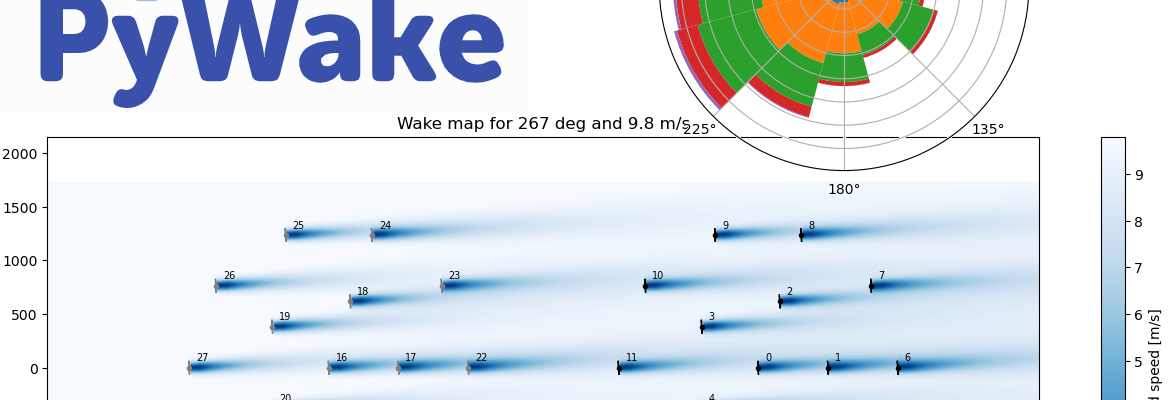
With the rapidly evolving field of renewable energy and software engineering, presented here is a Python backed opensource programme for simulating a wind farm. It is called PyWake. Existing approaches for simulation of a wind turbine utilising hand calculations, opensource software and paid software are of common application. However, for wind farm design, in most cases, a few turbines grouped together may be designed by hand calculations or paid software. This is where PyWake comes in. PyWake automates the simulation of a wind farm. To explore more on this application, see the post below. In the mean time, here is where the user documentation can be obtained.
User documentation can be found at: https://topfarm.pages.windenergy.dtu.dk/PyWake/
User documentation can also be downloaded here:

A simplified collection of calculations for onshore structures can be obtained from here: https://www.amazon.com/ONSHORE-STRUCTURAL-DESIGN-STEP-CALCULATIONS/dp/B08Z3QPNP5
Also available in Nigeria for: ₦18,500.00 Contact – +2348182035528
Udemy course: Onshore Structural Design – Step by Step Calculations | Udemy
See also:
- Onshore Structural Design
- How to Design Each Facility Feature
- Horizontal Vessel Design
- Vertical Vessel Design
- Above Ground Storage Tank Design
- Design Overview of a Wind Farm
- Wind Turbine System Design
- BladeComp Structural Blade Modelling
PyWake: Open-Source Wind Farm Design and Energy Production Modeling
As the world embraces renewable energy, wind power stands out as one of the most viable and widely adopted sources. However, optimizing wind farm layouts and understanding wake effects (the turbulence created by wind turbines) are complex tasks requiring advanced modeling. PyWake, an opensource Python library, has emerged as a powerful tool in this area. Designed to support wind farm designers, researchers, and engineers, PyWake helps streamline the modeling, simulation, and optimization of wind farms for improved energy production.
In this post, we’ll dive into what PyWake is, how it assists in wind farm design and energy production, and how you can leverage and even extend its opensource code for custom applications.
What is PyWake?
PyWake is an open-source Python library developed specifically for modeling and simulating wind farms. Developed by DTU Wind Energy, PyWake provides a framework to evaluate and optimize wind farm layouts and understand complex aerodynamic interactions within a wind farm.
Wind farms, with their numerous turbines, experience aerodynamic interactions—particularly wake effects, where the wind flow behind a turbine is reduced in speed and increased in turbulence. This can impact downstream turbines’ performance and efficiency. Understanding these effects and designing an optimized layout is essential for maximizing energy output.
PyWake uses various wake models to simulate and predict these effects, making it an invaluable tool in planning, designing, and analyzing wind farms.
Key Features of PyWake
PyWake is a modular and flexible library that offers several key features for wind energy modeling:
- Wake Modeling and Simulation: PyWake includes several wake models, such as the Jensen model, Bastankhah Gaussian model, and NOJ model, each suitable for different modeling needs. These models simulate how wakes from one turbine affect others within a farm.
- Farm Layout Optimization: PyWake enables layout optimization by allowing users to experiment with different turbine placements and orientations, ultimately improving energy output.
- Wind Resource Assessment: PyWake integrates wind resource data, which is crucial for understanding how environmental factors impact energy production across various scenarios.
- Energy Production Calculations: By simulating the wind flow, turbulence, and interaction between turbines, PyWake calculates energy production estimates, giving developers, researchers, and engineers a clear idea of expected performance.
- Customizable and Extendable: With PyWake’s modular structure, you can implement custom wake models, objective functions, and other features to tailor the simulation for specific needs.
How PyWake Helps in Wind Farm Design and Energy Production
PyWake plays a significant role in both the design and operational stages of wind farms. Here’s how it benefits each area:
- Wind Farm Design Optimization
Wake Effect Analysis: Wake effects cause energy losses in downstream turbines due to reduced wind speeds. PyWake’s wake models simulate these effects, allowing designers to optimize the layout to reduce such losses.
Optimizing Layout for Higher Production: By testing various turbine placements, designers can find optimal arrangements to maximize energy capture and efficiency.
Turbine Spacing: The ideal spacing between turbines helps avoid excessive wake interactions and turbulence, maximizing efficiency and reducing wear on turbines. PyWake allows designers to experiment with different configurations to identify the best setup. - Improving Energy Production and Efficiency
Accurate Production Estimates: PyWake’s simulation capabilities provide accurate energy production estimates based on wind resource data and wake interactions. This aids in financial planning and helps operators set realistic performance targets.
Performance Optimization: PyWake can be used to simulate various scenarios, helping wind farm operators adjust operational strategies in response to environmental factors or maintenance schedules, thereby improving efficiency.
Long-Term Planning: By simulating energy production over time, PyWake aids in understanding long-term performance and helps in planning upgrades or expansions for sustained output.
 Catchment of Resources
[…] PyWake Wind Farm Simulation Programme […]