Rigid pavement or concrete slabs on grade (on the ground) serve several purposes. They may be used to prevent growth of vegetation in a residential or public location, it may be used as surfacing for industrial facilities for equipment and vehicles, it may also be used for highway construction. The strength and durability features of such pavements depend on the load to be carried by such structures and the longevity.
When planning on designing/constructing a rigid pavement, it is important to consider the available options. Concrete slab on grade may or may not be reinforced. The choice as to whether or not to include reinforcements depends on the structural requirements, available funds and the nature of the supporting ground to mention a few. Another characteristic of rigid pavement is whether there are longitudinal and lateral joints or not.
See also:
- Onshore Structural Design
- How to Design Each Facility Feature
- Horizontal Vessel Design
- Vertical Vessel Design
Available standards such as those from AASHTO and ‘Concrete Industrial Floors on the Ground’ details recommendations on how to properly size a concrete slab. Such sizing may be slab thickness, length of a pavement before insertion of a joint etc. The location of joints and reinforcement type/presence have resulted in classification of rigid pavement types.
Types of concrete pavement are listed thus:
CPCD – Concrete Pavement Contraction Design
This pavement type consist of a plain cement concrete pavement with limiting dimensions between joints of below 5 meters. The slab does not have reinforcements except for dowels and tiebars.
JRCP – Joint Reinforced Concrete Pavement
This pavement type consists of joints between segments of concrete of up to 20 meters length. There are top reinforcements or both top and bottom reinforcements. Also included are dowels
and tiebars for the slabs.
CRCP – Continuously Reinforced Concrete Pavement
This consist of more heavily reinforced pavements which do not have joints occurring along the longitudinal/transverse length of the pavement. Also included are main reinforcements; however,
there are no dowels and tiebars in CRCP. This lack of joints results in a pavement with surfacial cracks. These cracks should not be of concern as the slab is held together by the reinforcements.
PCP – Post-tensioned Concrete Pavement
This consist of steel cables used in place of reinforcement bars. This cables are tensioned in order to prestress the concrete slab.
CP – Composite Pavement
Composite pavements on the other hand consist of both plain concrete and another layer of asphaltic surfacing.
Reinforcements for Rigid Pavements
Main/distribution reinforcements
These are often top bars both ways and top & bottom bars both ways. They are used for crack control, and load bearing. They are placed at 50mm below the top or bottom surface of the pavement.
Dowels
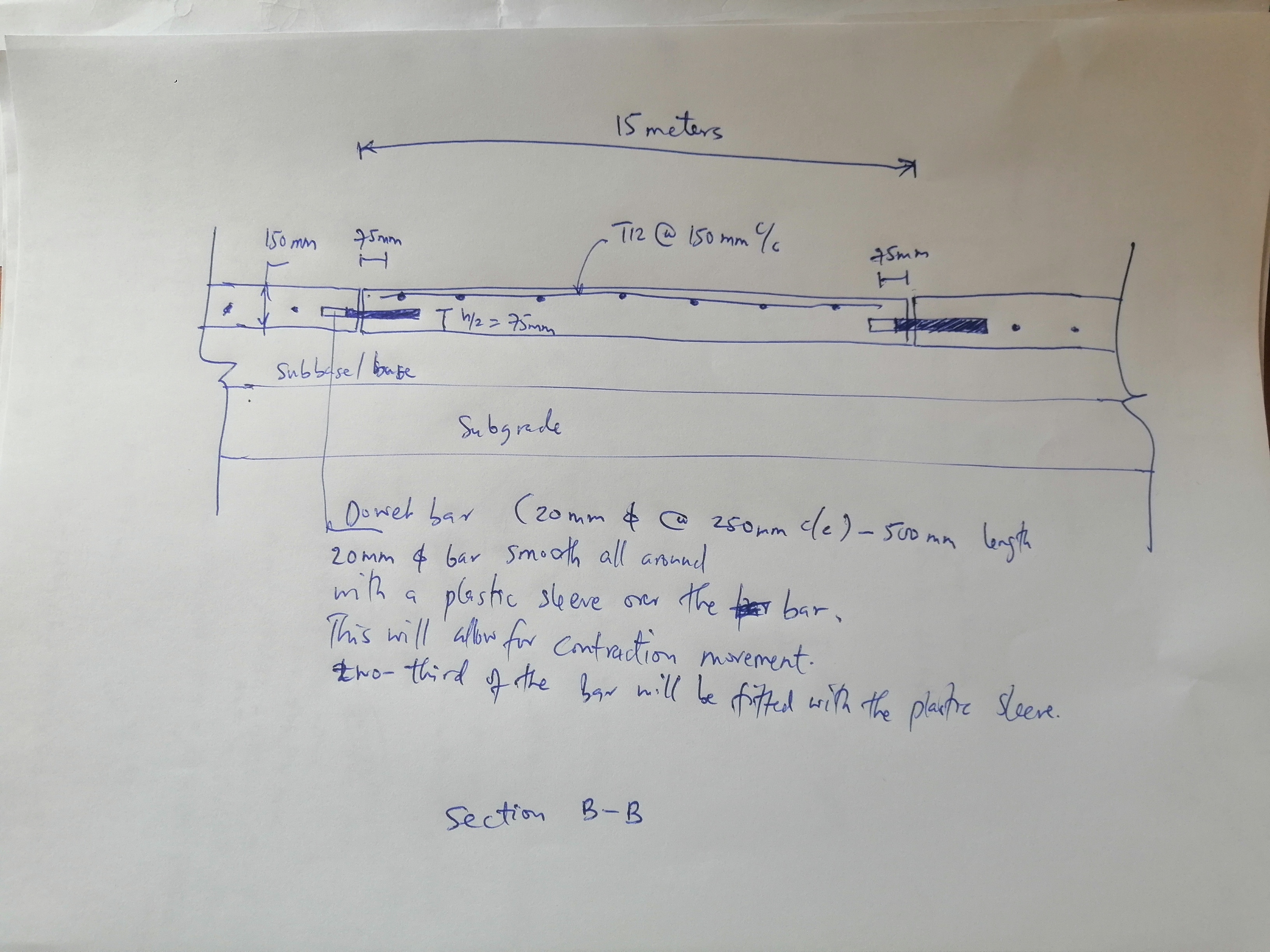
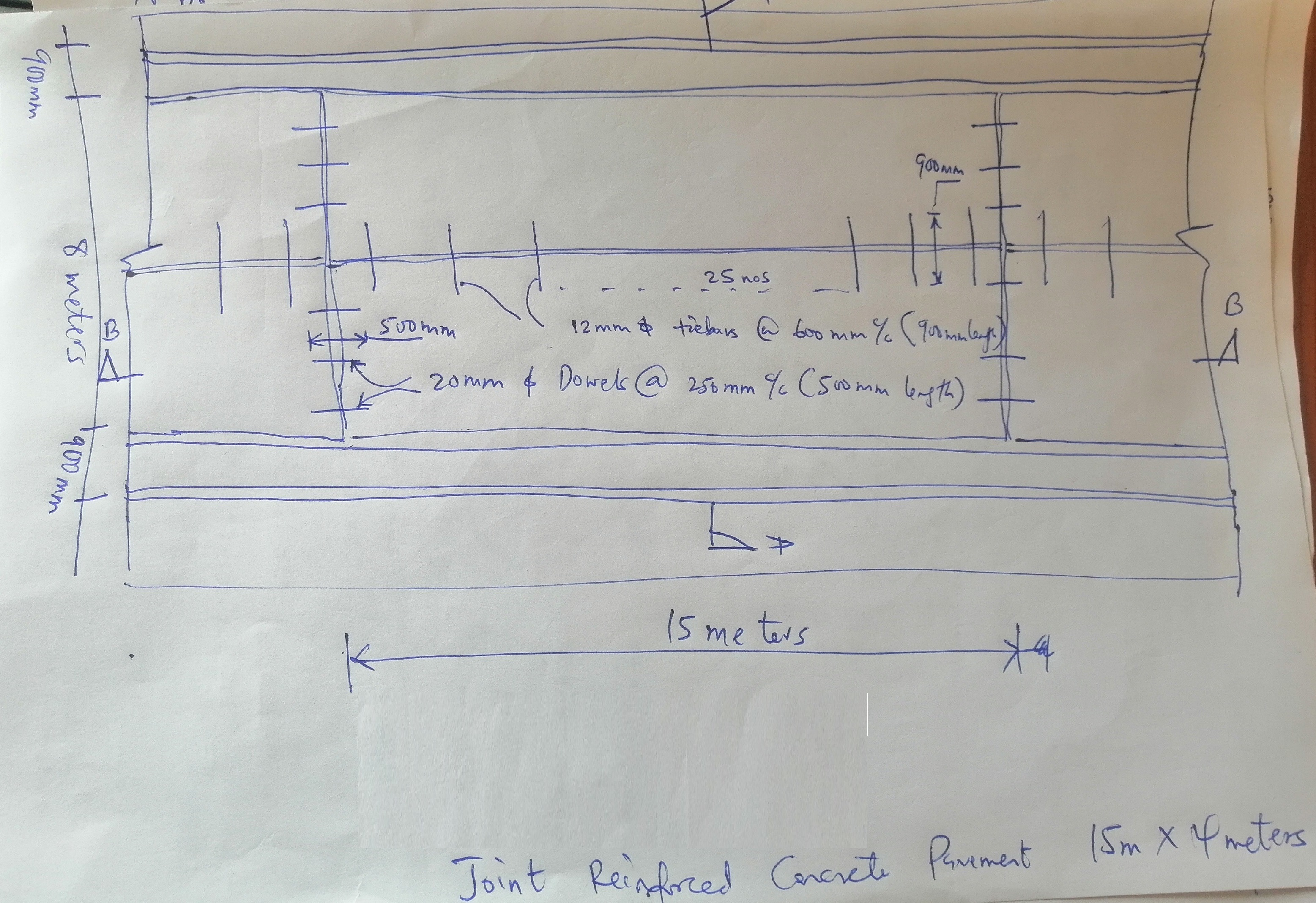
These are shorter bars which are placed at the mid-depth of the slab thickness and along the transverse joint of the pavements. (See photo for description of dowels). They are used to transfer load from one pavement segment to the next, such as: shear force, moments and ensures continuity; preventing differential movement. They often are smooth bars with a lubricating chemical applied (or a plastic sleeve) on two-thirds of the bar to allow for contraction movement.
Tiebars
These are also shorter bars which are placed at mid-depth of the slab and at longitudinal joints of the pavements. They ensure load transfer and ensure that there is continuity of the slab segments.
 Catchment of Resources