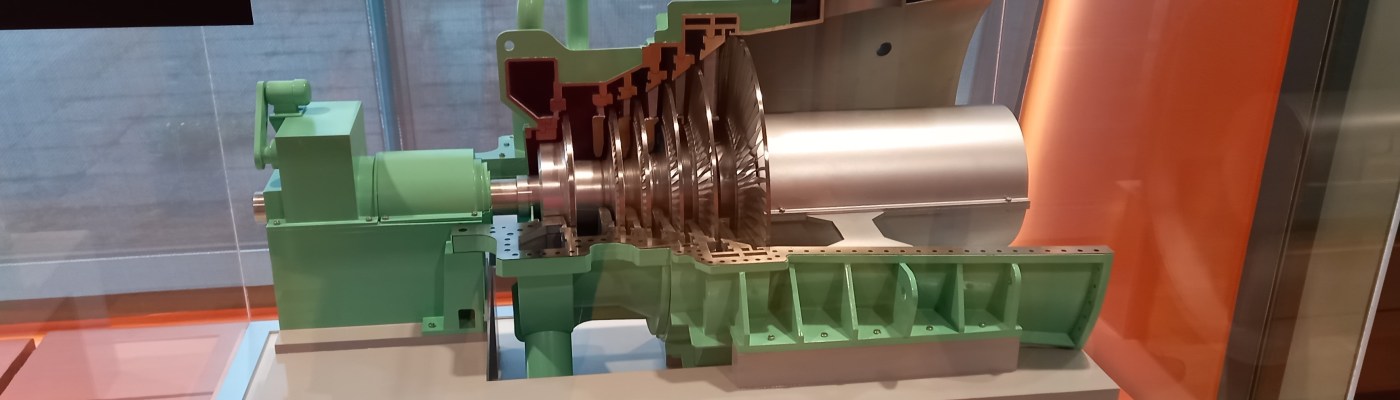
Equipment in used in petrochemical, energy processing and industrial facilities fall under two broad categories, namely: static equipment and rotating equipment. Some examples of static equipment are horizontal & vertical vessels, and pressure vessels while rotating equipment include turbines, compressors amongst others. Equipment which fall under the rotating category create a dynamic effect called vibration during their operation. In simplest terms, vibration in motorized equipment is the back-and-forth movement, or oscillation, of machines and components, such as drive motors, driven devices, and the bearings, shafts, gears, belts and other elements that make up mechanical systems. See video at end…
See also:
- Onshore Structural Design
- How to Design Each Facility Feature
- Horizontal Vessel Design
- Vertical Vessel Design
- Above Ground Storage Tank Design
Vibration in industrial equipment can be both a sign and a source of trouble. Other times, vibration just “goes with the territory” as a normal part of machine operation, and should not cause undue concern. During the design of the supports of these kind of equipment, care must be taken to ensure that any vibration is dissipated within the support and does not lead to movement of the foundation. There are basically two types of support foundation used for vibrating equipment; a slab support foundation and an elevated support foundation.
Slab support foundation: is a concrete slab foundation to which the machine and other auxiliary equipment is attached.
Elevated support foundation: consist of a concrete slab which supports columns and beams to which a template skid is attached. This skid is a steel frame which has the machine and other auxiliary equipment attached to it. See photos for both types of supports.
Similar to horizontal and vertical vessels, vibrating equipment are designed by an external manufacturer. The responsibility of the structural engineer is to obtain the data sheet from the manufacturer prior to commencement of the design calculations.
A simplified collection of calculations for onshore structures can be obtained from here: https://www.amazon.com/ONSHORE-STRUCTURAL-DESIGN-STEP-CALCULATIONS/dp/B08Z3QPNP5
Also available in Nigeria for: ₦18,500.00 Contact – +2348182035528
Udemy course: Onshore Structural Design – Step by Step Calculations | Udemy
Design Checklist
For a bird’s eye-view of the design process in general, there is a recommended checklist for assessment and design of foundations under machines. This can be helpful for supervisors and for less technical personnel as well.
| Item | Design Condition | Details |
| 1 | Static bearing capacity | 50% of the allowable soil pressure. |
| 2 | Settlement | The eccentricity of the machine center of gravity and foundation center of gravity is within 5% of any linear dimension. |
| 3 | Static plus dynamic loads | 75% of the allowable soil pressure |
| 4 | Settlement of static plus dynamic load | Satisfy item 2 and in case of rocking motion, the axis of rocking should coincide with the principal axis of the footing. |
| 5 | Magnification factor (applied for machine-generating unbalanced forces) | The calculated values of M should be less than 1.5 at resonance frequency. |
| 6 | Resonance | The acting frequencies of the machine should not be within +20% of the resonance frequency. |
| 7 | Transmissibility factor | Transmissibility factor should be less than 3%. |
| 8 | Resonance of individual structure component | The resonance condition with the lowest natural frequency shall be avoided by maintaining the frequency ratio <0.5 and >1.5. |
Source: Onshore Structural Design Calculations, Dr. Mohamed El-Reedy
More available in the book Onshore Structural Design – Step by Step Calculations…
Below is a short video of foundation design analysis.
 Catchment of Resources
[…] Vibrating Equipment Foundation […]
[…] Vibrating Equipment Foundation – Checklist for Design […]
[…] Vibrating Equipment Foundation – Checklist for Design […]