Where does one begin if given a project arbitrarily and told to make a decision on the type of material for a pipe job. There are times where customer requests come from industries outside our specialty. And in a fast paced world, a mental overview of such a process is necessary. Piping as distinct from pipeline are the interconnections between units in a facility similar to a LAN; local area network, while a pipeline connects facilities at distant geographical locations, similar to a WAN; wide area network. The considerations towards sound decision making in pipe selection involve customer request, fluid involved, corrosion, temperature, pressure and cost. Here, we dive into the intricate aspects of piping/pipeline material selection and condense the information into a birds eye-view flowchart that can be utilised by experienced personnel and novices alike to solve real-world challenges.

See also:
- Onshore Structural Design
- How to Design Each Facility Feature
- Horizontal Vessel Design
- Vertical Vessel Design
- Above Ground Storage Tank Design
- Vibrating Equipment Foundation – Checklist for Design
- Compound/Complex Vibrating Equipment Foundation Design for Onshore Facilities

A simplified collection of calculations for onshore structures can be obtained from here: https://www.amazon.com/ONSHORE-STRUCTURAL-DESIGN-STEP-CALCULATIONS/dp/B08Z3QPNP5
Also available in Nigeria for: ₦18,500.00 Contact – +2348182035528
Udemy course: Onshore Structural Design – Step by Step Calculations | Udemy
1.0 Priority Considerations for Pipe Material Selection
1.1 Customer Request/Project Requirement
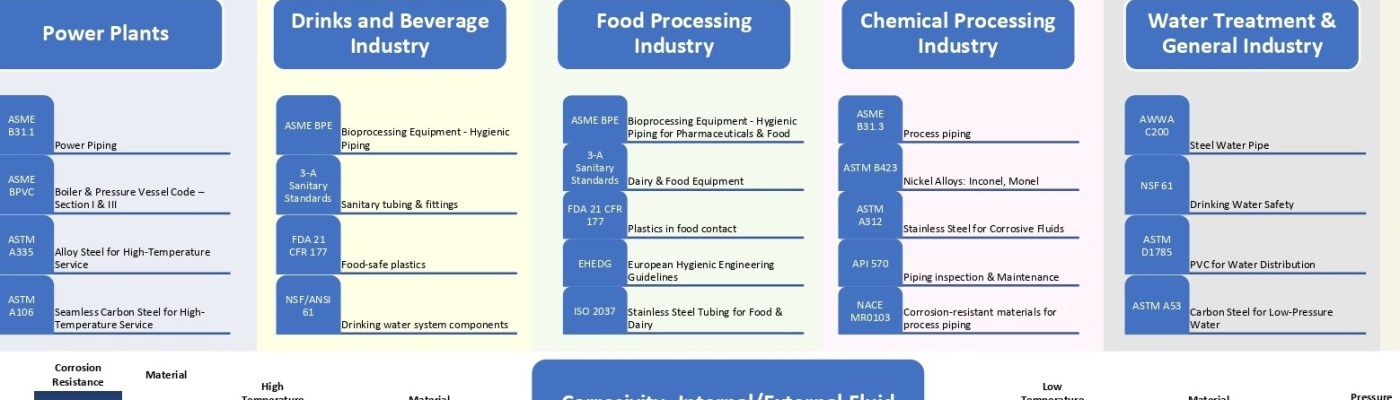
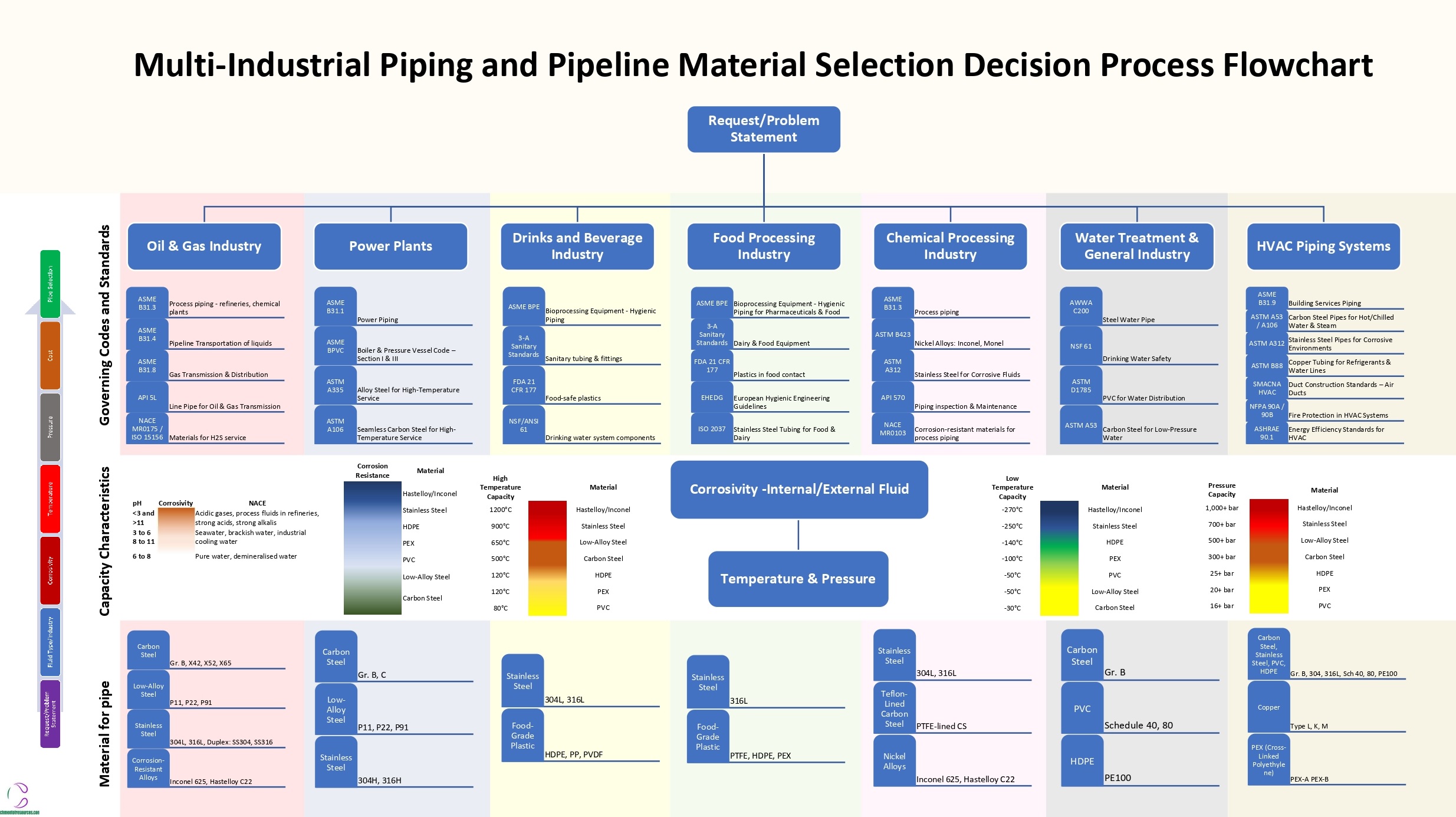
As a necessary step, a project requested often initiates the process. This step immediately reveals the industry being considered and the prevailing fluids to be designed for. It helps narrow down the unknowns with respect to governing standards/codes, fluid properties, environment properties, purpose for the pipe facility. Listed below are the governing standards and codes for each industry as captured in this study.
- Oil and Gas Industry
- ASME B31.3 (Process piping – refineries, chemical plants)
- ASME B31.4 (Pipeline Transportation of liquids)
- ASME B31.8 (Gas Transmission & Distribution)
- API 5L (Line Pipe for Oil & Gas Transmission)
- NACE MR0175 / ISO 15156 (Materials for H2S service)
- Power Plants (Thermal, Nuclear, Renewable)
- ASME B31.1 (Power Piping)
- ASME BPVC (Boiler & Pressure Vessel Code) – Section I & III
- ASTM A335 – Alloy Steel for High-Temperature Service
- ASTM A106 – Seamless Carbon Steel for High-Temperature Service
- Drinks and Beverage Industry
- ASME BPE (Bioprocessing Equipment – Hygienic Piping)
- 3-A Sanitary Standards (Sanitary tubing & fittings)
- FDA 21 CFR 177 (Food-safe plastics)
- NSF/ANSI 61 (Drinking water system components)
- Food Processing Industry
- ASME BPE (Bioprocessing Equipment – Hygienic Piping for Pharmaceuticals & Food)
- 3-A Sanitary Standards (Dairy & Food Equipment)
- FDA 21 CFR 177 (Plastics in food contact)
- EHEDG (European Hygienic Engineering Guidelines)
- ISO 2037 (Stainless Steel Tubing for Food & Dairy)
- Chemical Processing Industry
- ASME B31.3 (Process piping)
- ASTM B423 (Nickel Alloys: Inconel, Monel)
- ASTM A312 (Stainless Steel for Corrosive Fluids)
- API 570 (Piping inspection & Maintenance)
- NACE MR0103 (Corrosion-resistant materials for process piping)
- Water Treatment & General Industry
- AWWA C200 – Steel Water Pipe
- NSF 61 – Drinking Water Safety
- ASTM D1785 – PVC for Water Distribution
- ASTM A53 – Carbon Steel for Low-Pressure Water
- HVAC Piping Systems
- ASME B31.9 (Building Services Piping)
- ASTM A53 / A106 – Carbon Steel Pipes for Hot/Chilled Water & Steam
- ASTM A312 – Stainless Steel Pipes for Corrosive Environments
- ASTM B88 – Copper Tubing for Refrigerants & Water Lines
- SMACNA HVAC – Duct Construction Standards – Air Ducts
- NFPA 90A / 90B – Fire Protection in HVAC Systems
- ASHRAE 90.1 – Energy Efficiency Standards for HVAC
1.2 Corrosivity and Environmental Factors
Once the industry in question is ascertained, the unknowns as to the internal fluids of a pipe, and the possible external environmental fluids or chemical properties is clearer. It will be unheard of for a pipeline containing milk be transported via sea bottom means to a different geographical location. This however occurs for oil & gas products. Corrosion of a fluid or environment can be classed based on the pH level or from National Association of Corrosion Engineers, NACE for certain fluids.
In order to simplify classification, corrosivity can be classed into 3; Low corrosivity, Medium corrosivity and High corrosivity. Using the pH scale for measuring corrosivity, Low = 6 – 8, Medium = 3 – 8 & 8 – 11 and High = 0 – 3 & 11 – 14. These thresholds determine the minimum category a fluid or environment is to be rated for corrosivity. When it comes to the NACE classification, Low = Pure water, demineralised water, Medium = Seawater, brackish water, industrial cooling water and High = Acidic gases, process fluids in refineries, strong acids, strong alkalis.
A choice is often made with the maximum corrosivity class voted to govern for the whole pipe material. For example, installation of a pipe underground in earth materials or installation at sea bottom consists of 2 different pH environment values.
Certain materials provide sufficient corrosion resistance throughout the intended/design life span of a facility and retrofitting is also an option. Materials with resistance in Low corrosivity: carbon steel, low-alloy steel; Medium corrosivity: stainless steel, HDPE, PEX, PVC, PTFE, Teflon-lined carbon steel and High corrosivity: Duplex stainless steel, Alloys of Nickel: Hastelloy, Inconel. In other cases, a material lower in corrosion resistance is adopted and retrofitted with corrosion prevention features due to the cumulative cost effectiveness of the approach. For example, a carbon steel which is typical for a low corrosivity medium is modified for Medium corrosivity environment. This can be done by thickness buffer for corrosion, corrosion prevention such as fusion bond epoxy FBE and corrosion control such as cathode protection CP.
1.3 Temperature, Pressure and Cost Characteristics of Pipe Materials
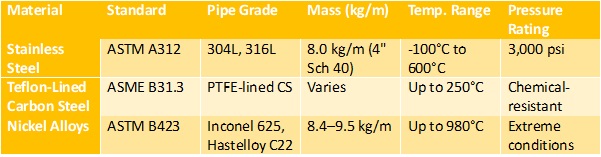
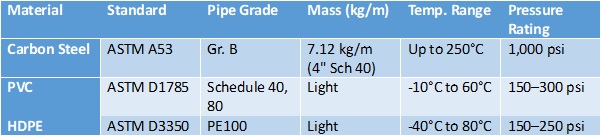
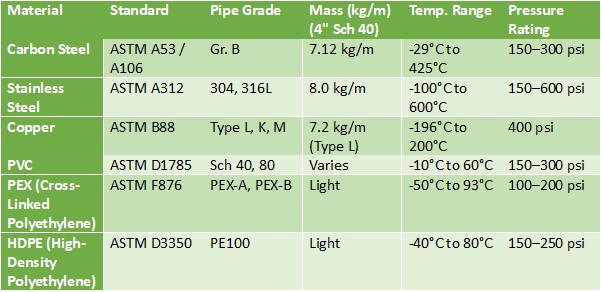
Having identified possible material candidates, the temperature and pressure capacities of these pipes should be confirmed. A selection is made of the pipe. Where multiple pipes still fit the bill, then a third control should be the cost of unit lengths of individual pipes. Which ultimately lays to rest any pipe selection controversy. Below in section 4.0 are tables showing the properties of common pipe materials as per the industry.
2.0 Multi-Industry Piping/Pipeline Material Selection Decision Flowchart
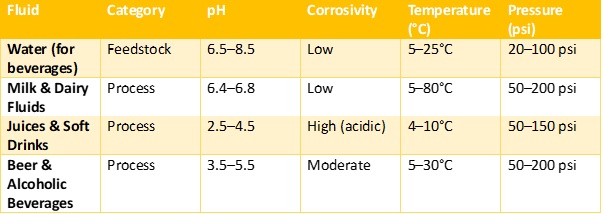
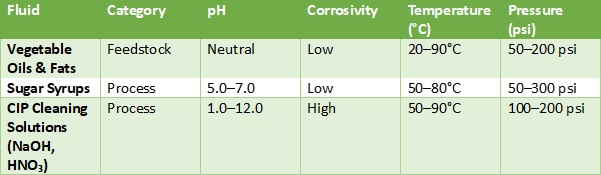
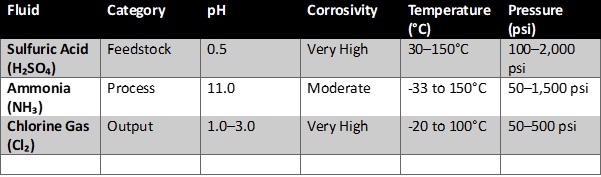
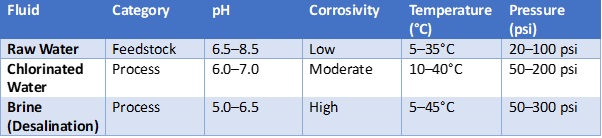
3.0 Multi-Industry Typical Fluid Properties for Pipe Selection
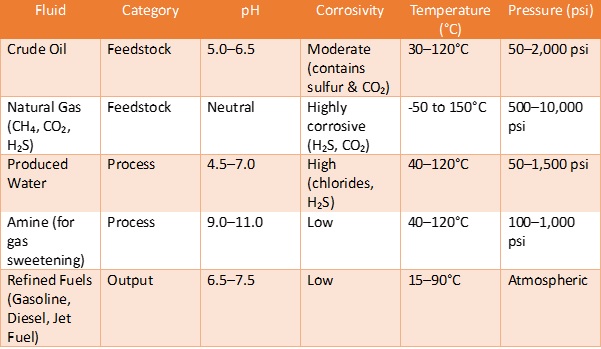
- Oil & Gas Industry
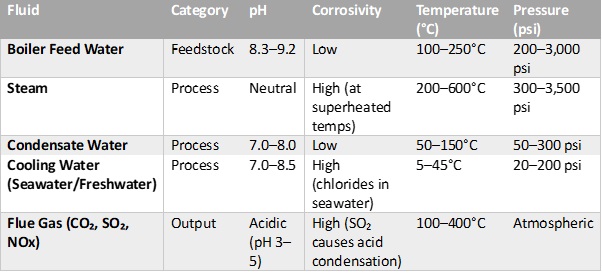
- Power Plants (Thermal, Nuclear, Renewable)
- Drinks and Beverage Industry
- Food Processing Industry
- Chemical Processing Industry
- Water Treatment & General Industry
- HVAC Piping Systems
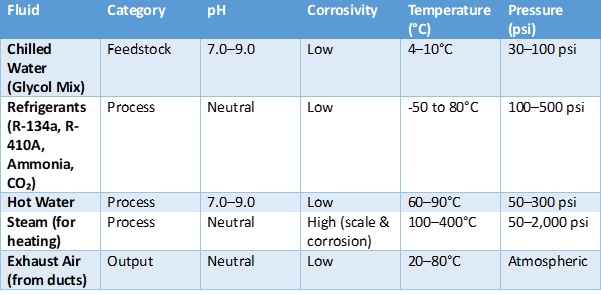
4.0 Properties of Common Pipe Materials per Industry
- Oil and Gas Industry
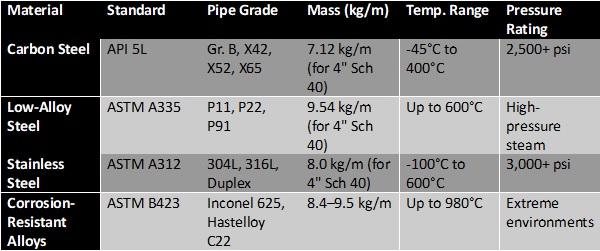
- Power Plants (Thermal, Nuclear, Renewable)
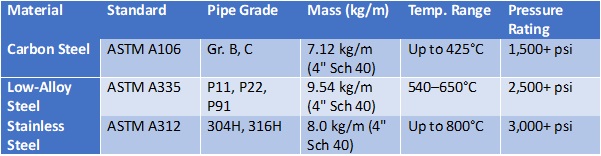
- Drinks and Beverage Industry
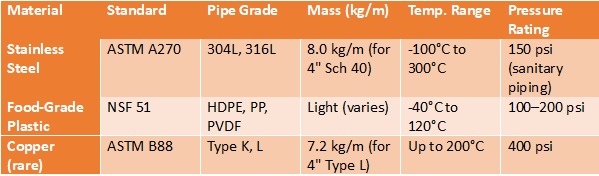
- Food Processing Industry

- Chemical Processing Industry
- Water Treatment & General Industry
- HVAC Piping Systems
 Catchment of Resources
[…] Multi-Industry Piping and Pipeline Material Selection Decision Flowchart […]